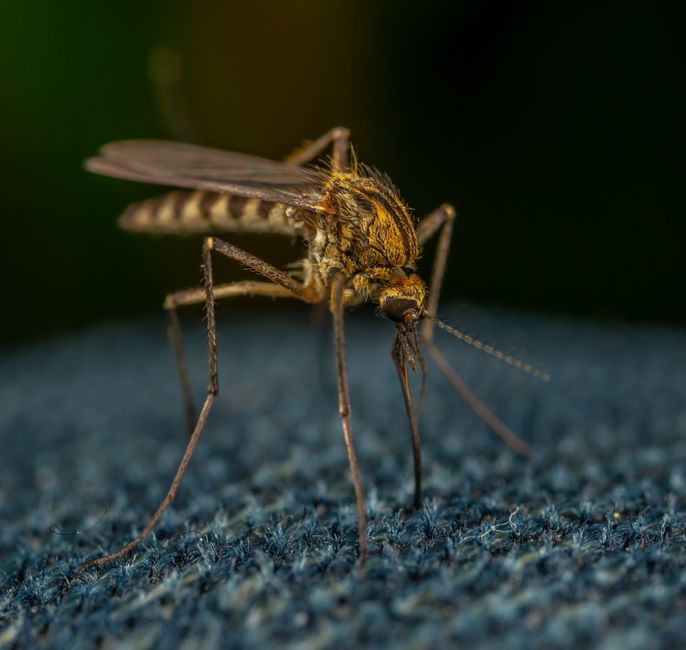

A New Way to Identify Dangerous Mosquitoes
Researchers from the University of Wollongong’s GIFT City campus have developed an AI device that can identify mosquito species simply by listening to the sound of their wingbeats. The innovation offers a faster and more practical way to distinguish between species whose role in disease transmission can vary significantly. Because different mosquitoes spread different illnesses, accurate identification is an important part of public health surveillance.
The system, created by Prof Kiran Trivedi and his student Harsh Shroff, uses a compact setup with an integrated microphone and display. According to the researchers, the device analyses the mosquito’s buzz and compares it with known acoustic signatures associated with different species. Built as a low-cost and portable tool, it is designed to work in the field without depending on internet access or laboratory infrastructure.
How the AI Device Works
The mosquito AI device was trained using publicly available recordings of mosquito sounds. By learning patterns in wingbeat frequencies and other audio characteristics, the model can classify species based on their distinct sound profiles. The research team reported that the model achieved 88.3% accuracy in identifying species, a promising result for a practical disease monitoring tool.
At present, the device can recognize three medically important mosquito groups: Aedes aegypti, Anopheles, and Culex. These species are especially significant because they are linked to major diseases. Aedes aegypti is known for spreading dengue, yellow fever, and zika, while Anopheles mosquitoes transmit malaria parasites. Culex mosquitoes are associated with encephalitis and filariasis.
Why This Matters for Disease Monitoring
Conventional mosquito identification often requires entomologists to collect larvae and examine them carefully, a process that can be time-consuming and resource-intensive. A portable mosquito monitoring system based on sound could reduce that burden and make species detection more accessible in areas with limited laboratory support. That could be particularly valuable for health agencies trying to respond quickly to local outbreaks.
The researchers also say the technology could become more powerful when deployed as part of a wider network. If multiple units are placed across different locations, they could monitor mosquito activity and provide real-time alerts about emerging disease hotspots. Such a system could help officials direct prevention measures earlier and more efficiently.
Global Interest in a Practical Public Health Tool
The device was recently showcased at the United Nations AI for Good Global Summit in Geneva, highlighting its relevance beyond the laboratory. Its appeal lies not just in the use of artificial intelligence, but in the fact that it translates AI into a practical public health application. For regions facing recurring mosquito-borne disease threats, an inexpensive and portable solution could make surveillance faster, cheaper, and easier to scale.
While wider field validation will be important, the early results suggest that buzz-based identification may become a useful addition to modern disease monitoring. By combining sound analysis, portability, and artificial intelligence, the new system points to a future in which mosquito surveillance can happen closer to where health risks emerge.
Key Terms
- Artificial Intelligence (AI): Computer technology that learns patterns from data and uses them to make decisions or predictions.
- Acoustic Signature: A distinctive sound pattern that helps identify a specific mosquito species.
- Wingbeat Sound: The buzzing noise made when a mosquito flaps its wings.
- Species: A particular type of living organism with its own characteristics.
- Entomologist: A scientist who studies insects.
- Larvae: The early life stage of insects before they become adults.
- Vector: An organism, often an insect, that carries and spreads disease-causing agents.
- Portable: Easy to carry and use in different places.
- Real-Time: Happening immediately or with very little delay.
- Hotspot: A place where disease activity or risk is especially concentrated.